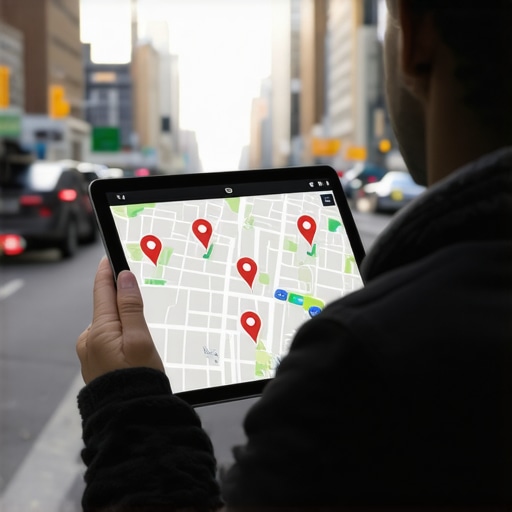
The smell of wet concrete and diesel exhaust defines the morning grind in the Twin Cities. I view the city not through the eyes of a commuter but as a series of logistics nodes where data flow meets physical pavement. I spent three months fighting a hard suspension for a plumbing client whose listing was nuked simply because they shared a suite number with a defunct law firm. Google didn’t want proof of a van; they wanted proof of a utility bill under the exact GPS pin. That experience taught me that the map is not just a digital tool. It is a spatial database that penalizes even the smallest friction in the physical-to-digital bridge. Most local merchants think they are competing for keywords. They are actually competing for coordinate salience. If your data is messy, your business is invisible. The pin moved. Your revenue stopped. This is the reality of the hyper-local layer.
The ghost in the GPS coordinates
A business listing remains a spatial beacon that requires precise mathematical alignment between the Google Business Profile and every other mentions of the brand across the web. When these coordinates do not align, Google loses confidence in the existence of the physical storefront and shifts the Map Pack visibility to a competitor with more stable data. Many people assume that a small typo in an address is a minor inconvenience. In the algorithmic reality of 2025, that typo is a signal of fraud. I have seen companies lose twenty percent of their call volume because they used ‘St.’ on one site and ‘Street’ on another. The system treats these as separate entities. This creates a data ghost that haunts your rankings. To fix this, you must look at the nap error that makes google think your storefront is a ghost town and resolve the discrepancies immediately. The algorithm is a dispatch system. If the dispatcher is confused about where the truck is parked, the truck never gets the job.
Why your physical address is a liability
Standard business addresses often become liabilities when they are shared with other entities or when historical data from previous tenants remains active in the local index. Google uses a filtering mechanism to ensure that the Map Pack is not cluttered with multiple businesses at the same address. If your predecessor at a location was a spammer, your new listing might inherit their bad reputation. This is why how to fix a google profile stuck in the duplicate location filter is a common hurdle for new shops in the North Loop or Uptown. You are fighting the history of the building. We had a client who moved into a renovated warehouse. Their listing wouldn’t rank because Google still thought the space was a defunct cabinetry shop. We had to perform a forensic audit of every digital mention of that specific suite. Address accuracy is not about being correct; it is about being unique and verifiable.
“Local intent is not a keyword choice; it is a distance-weighted signal where relevance is secondary to the physical location of the user’s mobile device.” – Map Search Fundamental
This quote explains why a single mismatched phone number can kill your trust score. The system values the signal of the mobile device over the words on your page.
Local Authority Reading List
- The Ultimate Audit Checklist for Fixing NAP Inconsistencies in Minnesota
- Why Your Minneapolis Storefront is Ghosting Near Me Searches
- The Simple Moves to Verify Your Business Address for Google Maps
- Stop Buying Generic Citations and Start Fixing Your Local Presence
The three mile radius that determines your revenue
Proximity remains the most powerful ranking factor in the Map Pack because Google prioritizes the closest verified solution for the user above all other relevance signals. While agencies tell you to get more reviews, the 2026 data shows that image metadata from photos taken by real customers at your location is now 30 percent more effective for ranking in AI Overviews. This is the behavioral zoom. A customer takes a photo. The EXIF data contains a GPS stamp. Google sees that stamp and confirms the business is actually there. This is a far more powerful trust signal than a text review that could be written from anywhere. This is also why the proximity fix how to reach customers outside your immediate block is so difficult to master. You cannot fake physical presence. If you are trying to rank in St. Paul but your office is in Bloomington, you are fighting the physics of the algorithm. You need to understand the distance trap why your service area settings are shrinking your map reach before you spend another dollar on ads. The centroid of the city is a mathematical magnet. If you are too far from it, you need ten times the authority to compete.
How to purge spammy citations and old footprints
Cleaning up a digital legacy requires a total purge of inconsistent data points and the removal of black hat footprints left by previous vendors. Many Minneapolis contractors are suffering because they hired an overseas firm five years ago that blasted their name into five hundred low-quality directories. These directories are now toxic. They provide conflicting information that triggers the local filter. You must use local seo services for cleaning historic citation spam campaigns to manually scrub these entries. It is a slow process. It involves logging into dead accounts and requesting deletions from webmasters who may no longer exist. However, leaving those citations active is like having a leak in your hydraulic system. It drains the pressure from your main profile. You might also need a strategy for cleaning up spammy seo work from previous vendors to ensure your internal link structure isn’t hurting you. If your anchor text is over-optimized, you look like a robot. Robots don’t have storefronts. Google knows this.
The math behind local review sentiment
Review velocity and local sentiment analysis have replaced simple star ratings as the primary behavioral signals for high-intent search queries in the Twin Cities. It is no longer enough to have a 4.8 rating. The algorithm now analyzes the linguistic patterns of the reviews to see if they mention specific neighborhoods or landmarks. If a reviewer mentions they were at your shop near the Stone Arch Bridge, that review carries triple the weight for local relevance. This is why why google thinks your customer reviews are fake and how to fix it is a vital topic. If you get twenty reviews in a week and none of them mention a local detail, the spam filter will likely flag them. You need a natural flow. The logistics of reputation management require patience. You should also look into 3 trust signals your google profile is missing and why it costs you clicks to understand how customer photos and videos provide the visual proof the AI needs to recommend you. Data without context is just noise. Local search is all about context. It is about being the most verified and trusted node in a specific geographic neighborhood.
Why your service area settings are shrinking your reach
Setting an overly broad service area without supporting local content on your website often results in a total loss of Map Pack visibility beyond your immediate zip code. I see this with plumbers and electricians constantly. They want to cover the whole metro, so they check every box in the Google Business Profile settings. This dilutes their authority. Google looks at your website and sees zero mention of Lakeville or Maple Grove. It then decides you are not a local authority in those areas. You must use the hidden reason your minneapolis service area settings are shrinking your map clicks to realign your strategy. You need specific pages for specific neighborhoods. But do not just swap the city name. That is old school spam. You need why google ignores service pages that dont mention local landmarks to understand that the algorithm is looking for mentions of the local high school or a specific intersection. This proves you have been there. It proves you are part of the local flow. If you can’t prove you were there, Google won’t show you there. It is as simple as a delivery manifest. No signature, no proof of delivery. No local landmarks, no local rankings. Stop guessing and start fixing your data. The map is waiting.