Why Your Google Maps Keyword Tracking Data Doesn’t Match Your Actual Shop Visits
You’ve seen the reports. Your SEO agency sends over a monthly PDF filled with vibrant green circles and the number “1” prominently displayed next to your most valuable keywords. According to the data, your google business profile seo strategy is a resounding success. You’re dominating the local map pack. But when you look at your shop floor, it’s empty. The phone isn’t ringing, and the “surge” in traffic promised by those green dots feels like a digital hallucination.
This is the “Green Report Paradox,” a phenomenon I see daily as a Local SEO Consultant. Business owners are being gaslit by their own data. In 2026, ranking #1 on a static report is no longer the definitive metric for success. The reality of google business profile seo is that a single ranking doesn’t exist. Google’s local algorithm is now so hyper-personalized and proximity-dependent that a “number one ranking” might only exist for a person standing in your parking lot – or worse, it might only exist for the server used by your tracking software.
To understand why your shop visits aren’t matching your tracking data, we have to dismantle the myths of traditional reporting and look at the technical, algorithmic, and human factors that govern the modern Google Maps ecosystem.
The “Single Rank” Myth: Why Your Tracker is Lying to You
The biggest misconception in local search is the idea that your business has a fixed rank. Most business owners believe that if they search for “plumber” in their city, the results they see are the same results everyone else sees. This hasn’t been true for years, and in 2026, it’s a dangerous assumption.
Google doesn’t store one fixed number for your business in a database. Instead, it builds a brand-new ranking every single time a user hits the “search” button. This calculation happens in milliseconds and factors in the user’s precise latitude and longitude, their past search history, the time of day, and even the speed at which they are moving. Traditional rank trackers often ping Google from a static IP address or a single coordinate – usually the geographic center (the centroid) of a zip code or city.
If your google maps rank tracker is only checking your position from the city center, but your actual customers are searching from the suburbs or a neighboring business district, the report you receive is functionally useless. This is a core reason Why Your Minnesota SEO Agency Reports Don’t Match Your Actual Lead Count. You are looking at a snapshot of a single coordinate, while your customers are a moving target spread across a 10-mile radius.
Furthermore, many low-cost ranking services use “clean” browsers with no search history. Real users have “baggage.” If a user has clicked on your competitor’s listing three times in the last month, Google is more likely to show that competitor to them again, regardless of your “rank #1” status on a sterile tracking report.
The Proximity Gap: How 10 Blocks Changes Everything
Proximity remains the most volatile variable in the local search triad (Proximity, Relevance, and Prominence). We often talk about google business profile optimization as a way to “beat” the algorithm, but you cannot optimize your way out of being 10 miles away from a searcher when a competent competitor is only 2 blocks away.
Imagine two users searching for “emergency dentist.” User A is sitting in a coffee shop three blocks from your clinic. User B is in a car, 10 blocks away, heading toward your neighborhood. Even with that small distance, the Map Pack results can shift entirely. User A might see you at #1, while User B sees you at #5, buried behind the “More Businesses” button.
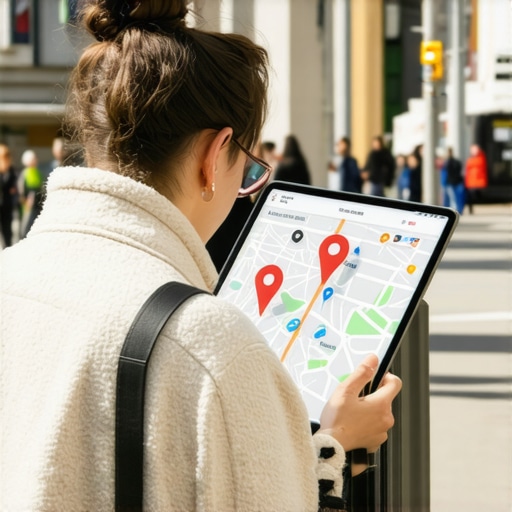
This is where a high-quality google maps rank tracker becomes essential. Instead of a single list, you need a geo-grid – a visual representation of your rank across hundreds of data points. If your “green” report only shows success at your front door, you aren’t actually ranking; you’re just existing.
In 2026, the “Proximity Filter” has become even more aggressive. Google’s AI now recognizes “service area density.” If there are 50 plumbers in a 5-mile radius, Google will tighten the proximity radius for each one to ensure “variety” in the search results. This means your visibility might drop off a cliff just a few blocks from your physical location. If your tracking data isn’t accounting for this “drop-off zone,” you’ll be left wondering why your #1 ranking isn’t generating foot traffic.
Device Class and Session Context (The 2026 Filter)
How a user searches is just as important as where they search. We have entered an era where Google’s algorithm distinguishes between “Research Intent” and “Immediate Intent” based on the device and session context. This is a critical component of google business profile ranking that most reports ignore.
- The Desktop Researcher: A user searching at 9:00 AM on a Monday from a desktop computer is often in “research mode.” They might be looking for prices, reading reviews, or comparing services for a future date. Google may show a broader range of businesses, prioritizing prominence and long-form content.
- The Mobile Searcher: A user searching at 9:00 PM on a Saturday from an iPhone is looking for immediate action. They want a “near me” solution right now. Google’s 2026 algorithm prioritizes “Human-Proofed Content” and proximity for these searches.
If your SEO strategy is built around high-volume keywords that people primarily search for on desktops, your “rankings” might look great, but they won’t convert into shop visits because those users aren’t ready to drive to you yet. Conversely, if you are losing the mobile battle, you are losing the customers who are literally around the corner. This is why many businesses find that Why Your Minneapolis SEO Keywords Fail the 2026 Context Test; they are optimized for the wrong intent at the wrong time of day.
In 2026, Google has also introduced more sensitivity to “robotic” signals. If your ranking is propped up by automated backlink bursts or keyword stuffing rather than genuine human engagement, the mobile algorithm – which is more sensitive to real-world user behavior – will often demote you in favor of businesses with authentic local footprints.
The Engagement Threshold: Why Being #1 Isn’t Enough
One of the most sobering truths I share with my clients is this: You can rank higher on google maps and still fail to get a single customer. This happens when a business hits what we call the “Engagement Threshold.”
Google’s primary goal is to provide the best user experience. If Google puts you at #1 for the keyword “best Italian restaurant,” and 100 people see your listing but only 2 people click on it, Google receives a signal that you are not actually the “best” or perhaps not even relevant. Over time, Google will demote your listing, even if your technical SEO (citations, N-A-P consistency, keywords) is perfect.
This is why google business profile optimization must focus on Click-Through Rate (CTR) and conversion, not just position. Factors that influence this include:
- Review Velocity and Sentiment: Are you getting fresh reviews daily, or is your last review from 2023?
- Visual Appeal: Does your primary photo look like a professional storefront or a blurry basement?
- Google Updates: Are you using the “Posts” feature to show you are active?
If your rank tracker shows you at #1, but your listing looks unappealing or untrustworthy compared to the business at #3, the “shop visits” will go to your competitor. Google has an implicit engagement threshold; if you don’t meet it, your “green” ranking is a house of cards. Furthermore, the “72% Factor” suggests that while many owners see positive reports, actual user experience on platforms like Reddit shows businesses “ghosting” or disappearing from Maps due to “drifting pins” or “ghosting” filters triggered by poor engagement signals.
Performance Metrics vs. Rank Trackers: A Better Way to Measure
If you want to know the truth about your google maps ranking service, you need to stop looking at keyword positions and start looking at the New Merchant Experience (NMX) Performance Metrics. Google recently rebranded “Insights” to “Performance” for a very specific reason: they want to emphasize user action over mere impressions.
A rank tracker tells you that you were visible. Performance metrics tell you if you were useful. The only metrics that truly correlate with shop visits are:
- Direction Requests: This is the strongest signal that someone is actually coming to your store.
- Calls: Direct intent to inquire or book.
- Website Clicks: Intent to learn more before visiting.
- Bookings/Messages: High-intent conversions.
If your rank tracking report shows a 20% increase in rankings but your “Direction Requests” in the Google Business Profile dashboard are flat or declining, your rankings are “hollow.” They are likely for keywords that don’t drive traffic or in locations where you aren’t actually competitive. Learning How to Spot a Minnesota SEO Company Faking 2026 Growth Stats often starts with comparing these two data sets. If the “rankings” go up but the “interactions” stay the same, the rankings are likely being manipulated or measured from irrelevant coordinates.
The Ghosting and Drifting Pin Phenomenon
Another technical reason for the mismatch between data and reality is the “Drifting Pin.” Google’s map data is not static; it is constantly being updated by user suggestions, AI image recognition from Street View, and third-party data aggregators. Sometimes, a business’s physical pin “drifts” in the database.
Your gmb ranking service might still see your business as being in its original location because it’s using cached data or API calls that don’t reflect the live map. However, to a real user, your pin might have moved to the middle of an intersection or a block away, causing them to get frustrated and cancel their trip. In extreme cases, businesses experience “ghosting,” where they appear in search results but their pin disappears from the actual map interface. This is a technical nightmare that requires a deep google business profile seo audit to fix, and it’s a primary reason for The Hidden Reason Your Minneapolis Storefront Disappeared from Local Maps.
How to Audit Your Real Visibility (Step-by-Step)
If you suspect your tracking data is lying to you, it’s time to perform a real-world audit. You need to move beyond lists and start using advanced local seo tools that provide a spatial understanding of your business.
- Run a Geo-Grid Report: Use a tool like SEO Viper Tools to see your rank across a 5×5 or 10×10 mile grid. This will show you exactly where your “visibility bubble” ends.
- Identify “Dead Zones”: Look for areas where your rank drops from #1 to #10 within a single mile. These are your “dead zones.” Often, these are caused by a specific competitor or a geographic barrier (like a river or highway) that Google’s algorithm respects more than your keywords.
- Check Your Mobile “Near Me” Presence: Physically go to a location where your tracker says you are #1. Open a private browser on your phone and search for your primary keyword. If you aren’t in the top 3, your tracker is using a centroid that doesn’t reflect real user behavior.
- Use a Google Business Profile Audit Tool: A comprehensive google business profile audit tool will check for “shadow suspensions” or “drifting pins” that might be suppressing your real-world traffic while leaving your search rankings intact.
By mapping your rankings to actual geography, you can begin to see the “Proximity Filter” in action. This allows you to stop wasting money on broad keywords and start focusing your gmb seo tools on the specific neighborhoods where you have a fighting chance of winning.
Conclusion: Moving Beyond the Rank Report
A successful maps seo campaign is measured in revenue, not green circles on a map. If your current reporting feels like a fantasy, it’s because it likely is. The “Single Rank” era is over. In 2026, the businesses that win are the ones that understand the fluid, proximity-based, and human-driven nature of the Google Maps algorithm.
Stop chasing a #1 ranking in a zip code. Start chasing “Visibility Distribution” and “Engagement Dominance.” You want to be the business that people click on, not just the one that appears on a list. You want a profile that is so “Human-Proofed” and engaging that Google has no choice but to show it to every relevant searcher within a 5-mile radius.
If you are tired of reports that don’t match your bank account, it’s time for a different approach. My name is Kevin Pauls, and I help businesses look past the vanity metrics to find the technical gaps that are costing them customers. Whether it’s a proximity issue, an engagement threshold failure, or a drifting pin, there is always a reason why the data doesn’t match the reality. Let’s find it and fix it.