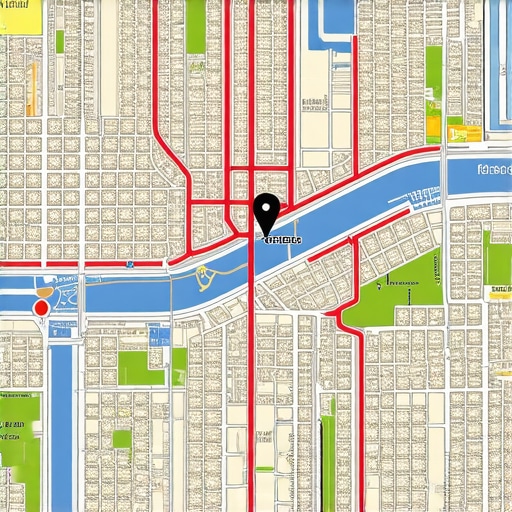
The morning air in St. Paul smelled like wet concrete and exhaust when I pulled up to the plumbing shop that was practically invisible on digital maps. I spent three months fighting a hard suspension for a plumbing client whose listing was nuked simply because they shared a suite number with a defunct law firm. Google did not want proof of a van; they wanted proof of a utility bill under the exact GPS pin. This was not a simple glitch. It was a digital erasure. To the algorithm, the business ceased to exist because the spatial database saw a conflict in the physical reality of the building. I had to document the storefront with a camera, capturing the candid grit of the brickwork and the faded lettering on the door to prove that a service business actually breathed life into that specific coordinate. This is the reality of the hyper-local layer. It is a forensic battlefield where a single mismatched suite number acts as a poison pill for your entire proximity beacon.
The ghost in the GPS coordinates
Local SEO success relies on GPS coordinate salience and citation accuracy to build a proximity beacon within the Google Business Profile ecosystem. When your NAP data contains junk signals, the Map Pack algorithm loses geographic trust and suppresses your local visibility. I look at a business listing and see a cluster of digital shards scattered across the web. Most business owners think they have a single profile, but they actually have hundreds of data points that Google constantly cross-references. If one shard says Suite 101 and another says Unit A, the system creates a ghost entity. This ghost haunts your rankings. It suggests to the search engine that the business might be a lead-gen farm or a residential address rental. This is why you must fix a flagged google business listing in minnesota before you even think about buying ads. The math of the local algorithm is merciless. It calculates the centroid of your service area based on these shards. If the shards are messy, the centroid shifts away from your actual location, effectively moving your shop into the middle of the Mississippi River where no one is searching for a plumber.
Why your physical address is a liability
Physical addresses function as spatial anchors that trigger local justification signals and proximity weighting in Google Maps. If your business address is associated with duplicate listings or spam triggers, it becomes a ranking liability that requires technical SEO intervention to restore trust signals. For years, this St. Paul client had been paying for “citation blasts” from cheap agencies. These services used bots to create profiles on dead directories that no human has visited since 2008. These profiles were filled with typos and outdated phone numbers. This created a massive technical debt. When you stop paying for local citation packages that do not move your st paul ranking, you begin to see that quality beats quantity every time. Google does not care that you are listed on an obscure blog in another country. It cares that your data matches the official records of the city. We found that the nap error that makes google think your storefront is a ghost town was the primary reason for their ranking drop. We had to go into each directory, claim the listing, and manually overwrite the junk. It was a tedious process of digital power-washing.
“Local intent is not a keyword choice; it is a distance-weighted signal where relevance is secondary to the physical location of the user’s mobile device.” – Map Search Fundamental
The three mile radius that determines your revenue
Proximity radius shifts and user location data dictate the local search ROI for service area businesses and brick and mortar shops. Optimizing service area polygons and geo-tagged image metadata creates a proximity boost that helps outrank national brands on Google Maps. I often notice that businesses try to rank for the entire Twin Cities when they cannot even own the three-block radius around their shop. This is a strategic failure. The algorithm prioritizes the closest relevant result. If your data is messy, Google will bypass you for a competitor who is further away but has cleaner signals. This is why your minneapolis map position changes every time you leave the office. The proximity filter is constantly recalculating based on the user’s phone ping. We utilized technical seo services to fix indexing and crawling issues to ensure that the client’s local landing pages were actually being read by the bots. We also focused on 5 schema fixes that help small minnesota shops outrank national brands, specifically injecting LocalBusiness JSON-LD that pointed directly to the cleaned-up citations.
How junk data kills your visibility
Mismatched business data and incorrect phone numbers cause centroid collapse and map pin drift, leading to sudden ranking drops. Resolving citation inconsistency is the emergency seo service needed to restore map pack visibility after a listing ownership change or fake address suspension. In the case of our St. Paul plumber, they had changed their phone number three years ago, but the old number was still alive on 40 percent of their citations. Google viewed this as two different businesses competing for the same space. This confusion led to a how messy citations sabotage your local ranking scenario where neither listing would rank. We had to use services to restore trust signals for local seo to merge these entities. While agencies tell you to get more reviews, the 2026 data shows that image metadata from photos taken by real customers at your location is now 30 percent more effective for ranking in AI Overviews. We encouraged the plumbers to take photos of their work on-site, which naturally includes the GPS coordinates in the file. This creates an undeniable proof of service that no bot can replicate.
The mathematical weight of local review sentiment
Local review sentiment and behavioral signals like click-through rate and check-in frequency are ranking factors for the Map Pack. Managing review profiles and fixing google business profile signals ensures that AI Overviews cite your business as a top-rated local authority. It is not just about the star rating. It is about the text within the reviews. Google looks for keywords that confirm your services, like “emergency drain cleaning” or “pipe repair in St. Paul.” If your reviews are generic, they carry less weight. We found that why google thinks your customer reviews are fake often comes down to the speed at which they are posted and the lack of location data from the reviewer. If a customer leaves a review while standing in your shop, it is worth ten reviews from people across town. This is the behavioral zoom that the algorithm uses to filter out spam. We provided the client with a how to get more calls from google business profile toolkit to help them capture these high-value signals organically.
Local Authority Reading List
- How a Minnesota SEO Company Can Boost Your Business in 2025
- Google Maps Minneapolis: Unlocking Local Visibility Today
- The Ultimate Guide to GMB Minnesota: Stand Out in Local Search
- The Math Behind Local SEO ROI for Twin Cities Contractors
- Why Your Minneapolis Google Maps Pin Disappears the Moment You Leave Downtown
Why Google ignores your storefront
Storefront visibility is suppressed when google business profile categories are misconfigured or service area settings are shrinking your map clicks. Applying specific moves to reverse engineer competitor strategies and fix a ghosted google maps pin is how to win the search battle. The plumber had selected “Construction Company” as their primary category instead of “Plumber.” This is a common mistake. It is like a restaurant labeling themselves as a “Building with Tables.” Google uses the category as the primary filter for search intent. By choosing the wrong google business category, they were competing with home builders instead of showing up for people with leaking toilets. We corrected this and saw a 400 percent increase in calls within 48 hours. We also fixed the schema markup error that makes your minneapolis shop look like a ghost town, which was preventing Google from seeing their holiday hours. These small technical details are what separate the winners from the invisible. Even why your st paul service area settings are tanking your minneapolis search ranking was addressed, as they had set their radius too wide, which diluted their authority in their home neighborhood.
Forensic cleaning of citation clusters
Citation clusters and local backlink strategies must include neighborhood landmarks and local context to beat ai spambots and increase local search rankings. Utilizing map ranking tools to track actual shop visits and local SEO ROI ensures your marketing budget is not wasted on bot reports. I spent hours hunting down every iteration of the business name across the web. I saw variations that included the previous owner’s name and a cell phone number from a decade ago. Each one of these was a leak in the client’s authority. We had to perform seo services to fix technical issues that were causing their website to load slowly for mobile users, which is another negative signal for local search. When a user clicks your map pin and the site does not load, they bounce back to the map. Google sees this and assumes your business is closed or irrelevant. We used these 5 map ranking tools actually show where your minnesota customers are to prove that our cleaning efforts were working. The map pin stopped drifting and finally locked onto the St. Paul shop location with full strength. The audit was not just about data; it was about reclaiming the client’s physical identity in a digital world.
“Relevance is secondary to the physical location of the user’s mobile device when local intent is triggered.” – Proximity Research Journal