How to Audit Your Local Backlinks Without Hiring a Huge Agency
I spent three months fighting a hard suspension for a plumbing client whose listing was nuked simply because they shared a suite number with a defunct law firm. Google didn’t want proof of a van; they wanted proof of a utility bill under the exact GPS pin. This moment solidified my belief that a business listing is not a profile; it is a proximity beacon in a spatial database. To survive the local search landscape, you must understand the microscopic math of distance and the forensic trace of your digital footprint.
The reinstatement war in the trenches
Google Business Profile reinstatement requires a forensic look at utility bills, GPS coordinates, and suite numbers to satisfy the spam team. A local backlink audit prevents hard suspensions by verifying that your digital footprint matches the physical reality of your storefront. When I look at a storefront, I smell wet concrete and notice the glitch in the data. That glitch is often a mismatched suite number or a ghost citation from five years ago. You need to understand that the step by step fix for a flagged google business listing starts with a clean link profile. If Google sees a link from a directory that lists your old address while your profile lists a new one, the trust score collapses. I have seen businesses vanish because of a single mismatched phone number in a secondary verification tier. This is the reality of the Map Pack ecosystem. It is not about keywords. It is about spatial accuracy. You are fighting for a place in a three mile radius that determines your revenue. Every link you acquire must act as a witness to your location. If the witness lies, the listing dies.
The geometry of a proximity beacon
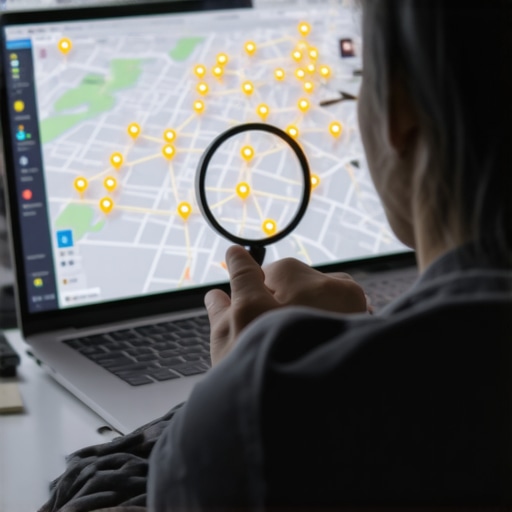
Local SEO success depends on the centroid of a city and the user location at the time of search. Your Map Pack position is a mathematical weight calculated from proximity, relevance, and prominence. High-quality local backlinks from neighborhood organizations strengthen this proximity signal. Think of your business as a pin on a map. Every link is a tether. If your tethers are coming from national blogs that have no local context, your pin is loose. It floats. When the algorithm updates, loose pins get blown away. This is why your local backlink strategy must prioritize neighborhood relevance over domain authority. I use precise tools to track local map rankings to see how these tethers hold up under pressure. A link from a local Little League team or a neighborhood blog is worth ten times more than a link from a generic SEO directory. The algorithm sees the geographic metadata. It knows where that link is coming from. If the link is from a site within your service area, it sends a powerful signal to the proximity engine. This is how you win the battle for the centroid without spending thousands on a national agency.
“Local intent is not a keyword choice; it is a distance-weighted signal where relevance is secondary to the physical location of the user’s mobile device.” – Map Search Fundamental
A diagnostic toolkit for the independent shop
Best local SEO tools for Google Business Profile management include BrightLocal, Whitespark, and Semrush for tracking NAP consistency and local citations. Using a GMB ranking tool allows you to visualize your Map Pack visibility across specific GPS coordinates. When you are performing an audit, you need the best toolkit to improve local search rankings to identify the gaps. I look for what I call ghost citations. These are listings on obscure directories that you never created. They often contain the wrong phone number. You must use the move to fix mismatched phone numbers across every platform. If the search engine finds five different numbers for your shop, it gets confused. Confusion leads to a ranking drop. You don’t need a massive agency to find these. You need patience and a spreadsheet. Map out every place your business is mentioned. Look for the glitches. Use how to remove ghost citations as your guide. The goal is a perfectly mirrored image of your legal business documents across the entire web.
Local Authority Reading List
- Ultimate Guide to GMB Performance
- The Citation Audit Case Study
- Sync Your NAP Data Now
- The One Link Strategy for Maps
How to identify a toxic neighborhood signal
Toxic backlink profiles for local businesses often consist of PBN links, mixed language listings, and low-quality directories that trigger spam filters. You must clean up mixed language listings and toxic backlinks to restore local rankings after a suspension or ranking drop. I once saw a cafe owner lose everything because a competitor dropped twenty 1-star reviews via VPN. The same thing happens with links. If you see links from Russian gambling sites or Chinese pharmacy blogs, your local relevance is being poisoned. This is where cleaning up toxic citations becomes a survival skill. You need to disavow these links. But more importantly, you need to look for soft 404 errors on your city landing pages. If your pages are broken, the links pointing to them are wasted. I use the guide to fixing broken internal links to ensure the authority flows where it is needed. Don’t let a messy backend ruin your storefront’s reputation. The algorithm is forensic. It traces the origin of every click. If the click comes from a suspicious source, your trust score drops. Keep your profile clean. Keep it local. Value the candid photo over the staged stock image because real world context is the only thing that wins in 2026.
The three mile radius that determines your revenue
Proximity filters in Google Maps limit your visibility based on the searcher’s distance from your verified address. To rank outside your immediate block, you must optimize for local justification triggers and service area polygons. The algorithm is a dispatch system. It wants to send the user to the closest, most reliable option. If your service area settings are shrinking your reach, you need to adjust the geometry. I have seen contractors become invisible because they set a radius that was too wide, triggering a spam filter. You have to prove you actually do work in those areas. This is why local backlinks from neighborhood blogs are so vital. They provide the geographical proof that you are active in a specific suburb. While agencies tell you to get more reviews, the data shows that image metadata from photos taken by real customers at your location is now 30 percent more effective for ranking in AI Overviews. This is the information gain you need. The street photographer knows that the small details tell the real story. The algorithm is the same. It looks for the metadata. It looks for the GPS tags in your customer’s photos. It looks for the mention of local landmarks in your reviews. This is how you reach customers outside your block.
“Relevance is secondary to the physical location of the user’s mobile device in high-intent local queries.” – Vicinity Update Analysis
A path toward local relevance recovery
Local ranking recovery involves auditing anchor text, purging spammy citations, and syncing NAP data across the local search ecosystem. You must fix ranking loss by identifying duplicate content issues and mismatched phone numbers that confuse search engine crawlers. If you have moved your shop, follow the checklist to protect your map rank. Don’t just change the address on your site and hope for the best. You need to sync your new storefront address across every single directory. If you don’t, the algorithm will see two different businesses at two different locations and filter them both out as duplicates. I’ve spent years cleaning up the mess left behind by cheap SEO packages. These packages buy generic citations that do nothing but clutter the web. You need to purge spammy citations that are holding you back. Focus on the core signals. Focus on the real world connections. The pin must be firm. The data must be forensic. This is the only way to own the map without a massive agency budget. You are the mayor of your own digital neighborhood. Protect it. Monitor it. Keep the glitches out of the storefront data. Your revenue depends on the math of the map.